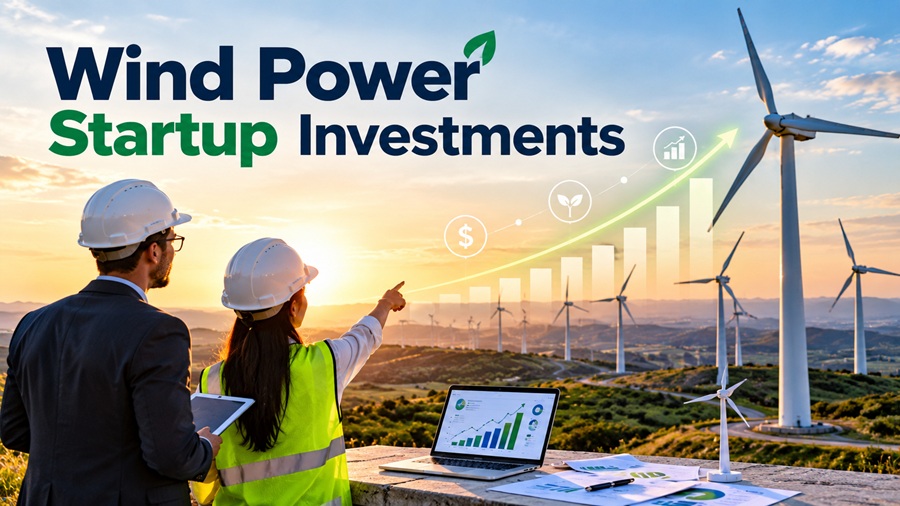
Wind power is one of the most mature renewable energy sources in the world, which creates an odd situation for investors. The big turbine makers are giant, established companies. So where does a startup fit, and how does an ordinary investor get a piece of it?
The short answer: wind power startup investments mostly sit in the layers around the turbine, not the turbine itself. Floating offshore platforms, airborne wind systems, blade recycling, predictive maintenance software and grid integration tools are where most venture money flows. Individual investors usually get exposure through equity crowdfunding platforms, publicly listed renewable energy companies or clean energy funds, since direct venture deals are typically limited to accredited or institutional investors.
Wind Power Startup Investing at a Glance
| Item | Summary |
| Where startups focus | Floating offshore wind, airborne wind, software, maintenance, materials, grid tech |
| Who funds them | Climate venture funds, corporate venture arms, governments, crowdfunding investors |
| Access for individuals | Equity crowdfunding, public stocks, renewable energy ETFs and funds |
| Typical holding period | Long, often five to ten years for private stakes |
| Main risks | Technology risk, policy shifts, financing costs, slow commercialization |
| Main upside | Exposure to long-term growth in clean electricity demand |
| Liquidity | Very low for private startups, high for public stocks and funds |
Why Wind Startups Look Different From Other Tech Startups
A software startup can launch a product in months with a laptop and a cloud account. A wind startup might need years of engineering, prototype testing at sea or in the field and certification before it earns real revenue.
That changes the investment math. Capital needs are higher, timelines are longer and the path to profit runs through utilities, developers and governments rather than individual app downloads.
It also explains why so much venture money avoids turbine manufacturing altogether. Companies like Vestas, Siemens Gamesa and GE Vernova dominate that space with enormous scale. A startup trying to out-build them head on faces steep odds. Startups that make those turbines cheaper to install, easier to maintain or usable in new locations have a much clearer lane.
The Main Segments Attracting Startup Money
Not every wind startup is chasing the same opportunity. The segments carry very different risk profiles.
| Segment | What They Build | Stage of Maturity | Risk Level |
| Floating offshore wind | Platforms, moorings and anchors for deep water turbines | Early commercial | High |
| Airborne wind energy | Kites or tethered drones that capture high altitude wind | Pilot and demonstration | Very high |
| Digital operations and maintenance | Sensors, analytics and predictive maintenance software | Commercial | Moderate |
| Blade materials and recycling | Recyclable blades and reuse of old blade material | Early commercial | Moderate to high |
| Grid integration and storage | Forecasting, balancing and pairing wind with storage | Commercial | Moderate |
| Small and urban wind | Compact turbines for buildings and farms | Mixed | High |
Floating Offshore Wind
This is arguably the most watched segment. Fixed bottom turbines only work in fairly shallow water, but many of the best wind resources sit over deep ocean. Floating platforms open those areas up.
Startups such as Gazelle Wind Power and Aikido Technologies have raised money to develop lighter, cheaper floating foundations. Gazelle is also an example of retail access done differently, having raised funds through equity crowdfunding from well over a thousand individual investors.
Airborne Wind Energy
Airborne wind sounds like science fiction. Tethered kites or wings fly in figure-eight patterns hundreds of meters up, where wind is stronger and steadier, and send power back to the ground.
Companies like Kitepower and Altaeros Energies have attracted funding, including backing from large corporate investors. It is exciting technology with real potential, but it remains mostly at demonstration stage. Investors here are buying a long shot.
Software and Maintenance
This is the least flashy segment and, for many investors, the most sensible. Wind farms lose serious money when turbines break down unexpectedly. Startups that use sensors, drones and machine learning to predict failures can show clear savings to customers quickly.
Revenue tends to come sooner, capital needs are lighter and the business model often looks like a familiar software subscription. Several climate investors have pointed to this layer as the strongest venture opportunity in wind.
Who Is Putting Money Into Wind Startups
Understanding who invests alongside you helps you judge a startup’s staying power.
Climate focused venture funds, including names like Breakthrough Energy Ventures and Energy Impact Partners, back companies across clean energy, wind included.
Corporate venture arms invest when a technology fits their own strategy. Energy companies, utilities and even automakers have backed wind startups. General Motors’ venture arm, for example, led a round in Norwegian floating wind developer Wind Catching Systems.
Governments and public development banks provide grants, loans and co-investment, particularly for offshore projects that need patient capital.
And individual investors increasingly come in through crowdfunding platforms, usually in early stage rounds where minimum investments are small.
How Individual Investors Can Get Exposure
Most people reading this will not be invited into a venture capital round. That does not mean the sector is closed off. It just means choosing the right route.
| Route | Minimum Investment | Liquidity | Risk | Best For |
| Equity crowdfunding | Often low | Very low | Very high | Investors who want direct startup stakes and can wait years |
| Angel investing or syndicates | Moderate to high | Very low | Very high | Accredited investors with sector knowledge |
| Public wind and renewable stocks | Price of one share | High | Moderate to high | Investors wanting liquid exposure |
| Clean energy ETFs and funds | Low | High | Moderate | Diversified, hands-off exposure |
| Renewable energy yield companies | Price of one share | High | Moderate | Income focused investors |
Crowdfunding gives the most direct startup exposure, but it comes with the highest odds of losing everything and very few ways to sell early. Many experienced investors treat crowdfunded startup stakes as money they can afford to lose entirely.
Public markets and funds will not give you pure startup exposure. They do give you liquidity, diversification and regular financial disclosures, which matter a lot in a sector this volatile.
The Risks That Catch Investors Off Guard
Wind looks like a guaranteed growth story on paper. Electricity demand keeps rising, data centers need power and governments want cleaner grids. Yet wind investments have disappointed plenty of people. A few risks explain why.
Policy whiplash. Offshore wind in particular depends on permits, leases and subsidies. Political changes in the United States have stalled or cancelled several offshore projects, and companies exposed to those projects saw their prospects change quickly. Startups that depend on a single country’s policy are especially vulnerable.
Interest rates. Wind projects cost a lot upfront and pay back over decades. When borrowing costs rise, the economics of new projects weaken, and the startups selling into those projects feel the slowdown.
Supply chain and cost overruns. Large offshore developers have written down projects after costs for steel, vessels and installation climbed. When customers are under pressure, they buy less from startups.
Technology that works but does not scale. A prototype that performs well in testing can still struggle to reach a cost per unit of electricity that competes with established options.
Long timelines. Even promising wind startups can take many years to reach meaningful revenue. Investors who need their money back in two or three years usually end up frustrated.
A Practical Due Diligence Checklist
Before putting money into any wind startup, whether through a crowdfunding page or a private deal, it pays to ask some pointed questions.
| Question to Ask | Why It Matters |
| Has the technology been tested outside a lab? | Field results are far more meaningful than simulations |
| Who are the paying customers or pilot partners? | Real developers or utilities signal genuine demand |
| How much capital is needed to reach commercial scale? | Underestimating this leads to heavy dilution later |
| Which markets does it depend on? | Single country exposure magnifies policy risk |
| Who else has invested? | Experienced climate or corporate investors add credibility |
| What happens to small investors in future rounds? | Crowdfunded stakes can shrink sharply as larger rounds arrive |
| Is there a realistic exit path? | Acquisition or IPO prospects determine how you get paid back |
A founder who answers these questions clearly and without spin is a good sign. One who dodges the capital question or leans heavily on future subsidies deserves extra skepticism.
Trends Worth Watching
A handful of shifts are shaping where wind startup money goes next.
Floating wind is moving from demonstration toward early commercial projects, especially in Europe and parts of Asia, where deep coastal waters make it necessary.
Rising electricity demand from data centers and electrification is reviving interest in every source of clean power, including wind paired with storage.
Blade waste is becoming a real issue as older turbines reach retirement, creating openings for recycling and recyclable materials startups.
And capital is concentrating in companies that reduce costs for existing wind farms rather than those trying to reinvent the turbine.
Weighing It All Up
Wind power startup investments sit at the intersection of a durable long-term trend and a lot of short-term uncertainty. The demand for clean electricity is not going away. But the startups chasing it face long development cycles, policy risk and capital needs that can wipe out early investors.
For most individual investors, a balanced approach makes sense: broad exposure through public companies or funds for stability, plus a small, carefully chosen slice of early stage startup stakes for anyone who wants to back specific technologies. Treat that slice like venture money, because that is exactly what it is.
This article is for general information only and is not financial advice. Consider speaking with a licensed financial advisor before making investment decisions.